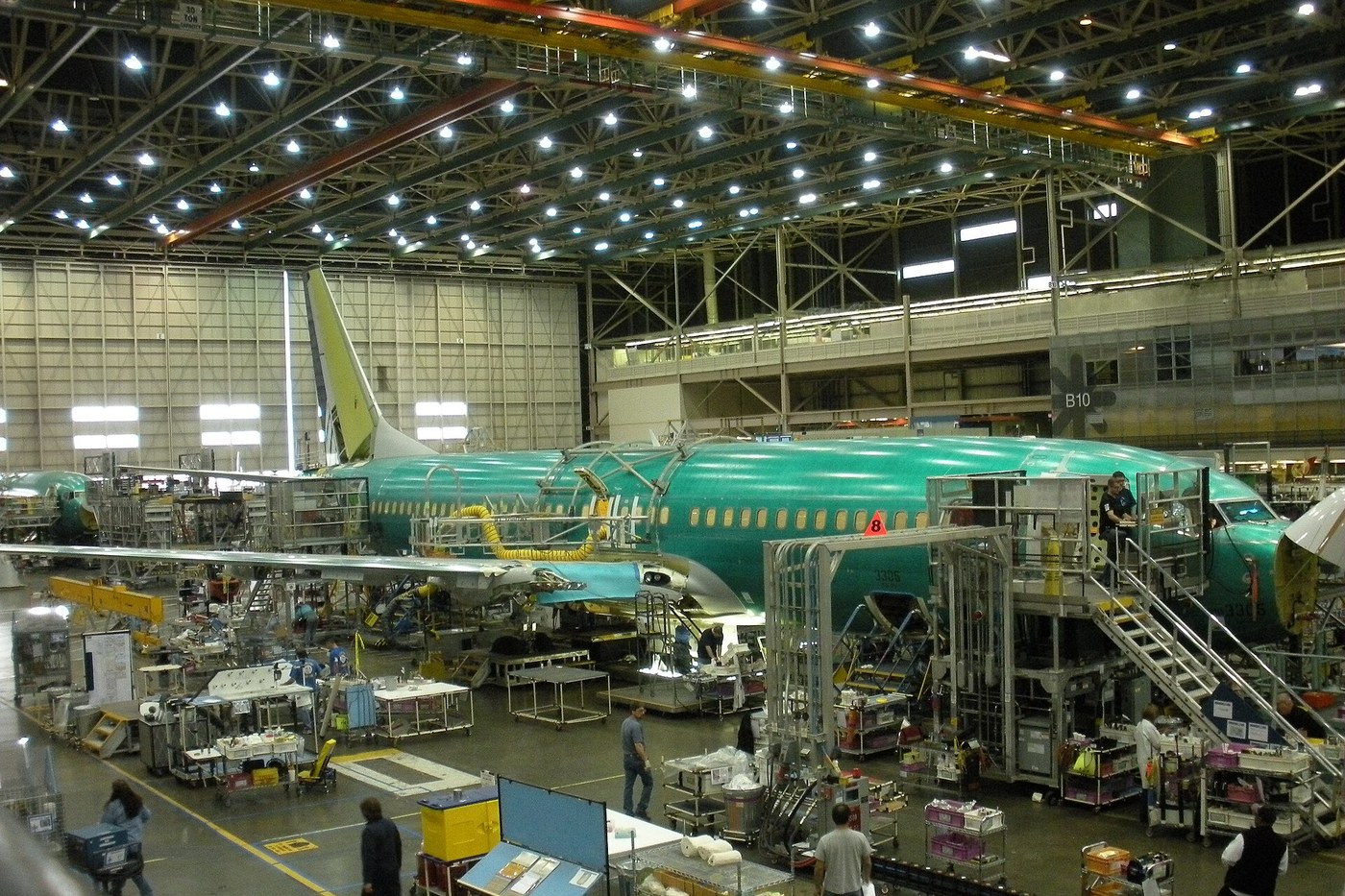
Boeing shares fell nearly 10% on Tuesday after the company said it will miss its 737 production and jet delivery targets this year, Reuters reported. Reuters said the drop was the stock’s worst day in more than 18 months, with shares down 9.6% to $170.23 in afternoon trading, and CNBC (opens in new tab) said the stock fell 10%. Chief Financial Officer Jay Malave said on the earnings call that the delay in stabilising production at 47 a month means Boeing will not reach its 500-delivery target this year, according to Reuters and a transcript of the call. Chief Executive Kelly Ortberg said Boeing still plans to increase to 52 jets a month in the second half of 2027, Reuters and CNBC (opens in new tab) reported.
The two outlets described the 737 rate differently. CNBC (opens in new tab) reported that Boeing has been manufacturing about 47 of its 737 MAX planes a month. Reuters reported that Boeing now expects to reach its 737 production-rate target of 47 jets a month in early 2027, and that as recently as May executives said they would hit that pace this summer. On the call, Ortberg said: “we continue to work towards stabilizing production at 47 airplanes per month,” that “it is taking us longer than we had expected to demonstrate performance at rate 47,” and that he expects “it will take us into next year to get fully stable at this rate,” according to a transcript published by Motley Fool. CNBC (opens in new tab) reported that Ortberg had told investors last month the stabilisation was taking a “little bit longer” than expected because of the pace of wing production.
Reuters reported that Boeing pushed back its free cash flow growth outlook by a year and now expects about $3 billion next year, against analyst consensus of $5.5 billion, according to LSEG data. On the call, Ortberg said he expects free cash flow to improve to about $3 billion in 2027 and about $6 billion in 2028, and to reach the $10 billion target in 2029, according to the transcript. Reuters quoted Tony Gabelli, an investment analyst at Gabelli Funds, as saying the market will punish any delay in increasing cash flow. “I know everybody wants us to go faster but we’re going to do it right,” Ortberg told CNBC (opens in new tab)’s Phil LeBeau on Tuesday.
For the three months ended Sept. 30, Boeing reported a net loss of $116 million, or 26 cents a share, compared with a $5.34 billion loss, or $7.14 a share, a year earlier, CNBC (opens in new tab) reported. The year-earlier figure included a nearly $5 billion charge on the 777X program. The adjusted loss was 34 cents a share against the 21 cents LSEG analysts expected, according to both outlets. Revenue rose 4% to $24.19 billion, ahead of the $23.84 billion expected, CNBC (opens in new tab) reported, and free cash flow rose to $464 million from $238 million a year earlier.
Boeing delivered 161 commercial airplanes in the quarter, one more than a year earlier, CNBC (opens in new tab) reported, and said it delivered 124 of them from the 737 program, according to the call transcript. Revenue in the commercial airplanes unit fell 3% to $10.72 billion, CNBC (opens in new tab) reported, with an operating loss of $697 million, according to Reuters. CNBC (opens in new tab) reported that the unit’s operating margin was negative 6.5%, which Boeing attributed to a “less favorable delivery mix, higher projected costs associated with future production rate adjustments and higher estimated supply chain costs.”
Defense revenue jumped 15% to $7.94 billion, CNBC (opens in new tab) reported. Reuters said the defense division earned nearly $500 million, helped by higher deliveries, better operational performance and a $252 million sale of a subsidiary. Boeing Global Services earned $1 billion with an 18.3% operating margin, and net debt ended the quarter at $25.2 billion, down from $25.9 billion in the prior quarter, according to Reuters.
Reuters reported that Boeing continues to struggle with production problems on its 787 program and 777 freighters, which Reuters first reported on Friday, and that Boeing expects the 777-9 to be on track for certification by mid-2027. The Federal Aviation Administration certified the 737 MAX 10 in October, following approval of the MAX 7 during the quarter, and the U.S. Navy picked Boeing for its next-generation F/A-XX fighter, Reuters reported. “Expectations are rising, and they should,” Ortberg said in a memo to employees after the results, according to CNBC (opens in new tab) and Reuters. In the same memo, as quoted by Reuters, he said: “We have a stronger foundation than a year ago, but we also have more work to do to deliver on our backlog, strengthen our culture, and improve how we work every day.”