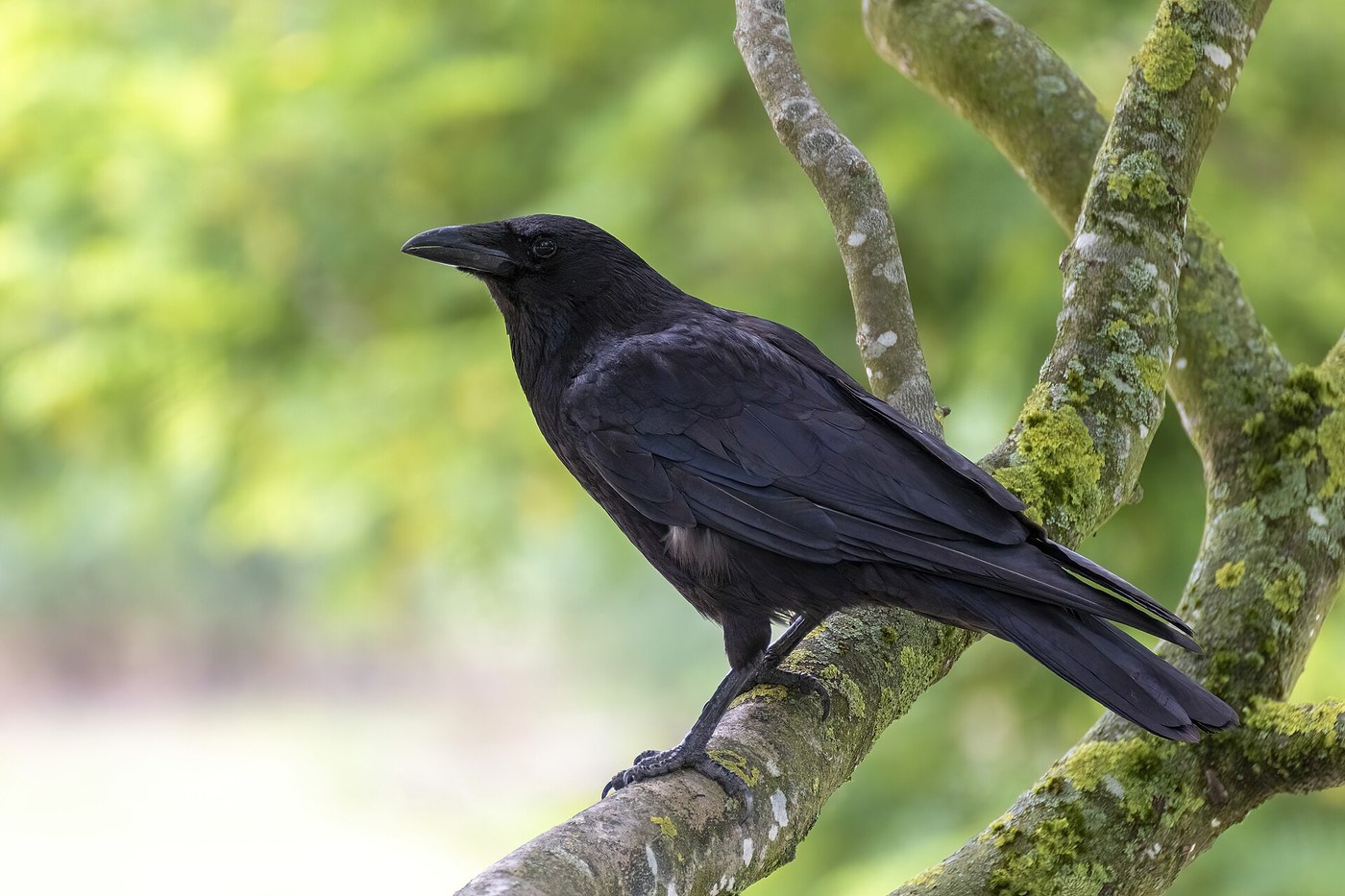
Two carrion crows took an average of 235 milliseconds to judge which way a pattern of dots was moving and to signal their choice, about twice as fast as monkeys and humans in earlier studies of similar tasks, researchers at the University of Tübingen reported in the journal Science. Philipp Schmidbauer and Andreas Nieder of the university’s Institute of Neurobiology published the study on Oct. 22.
The birds watched dots on a touchscreen and pecked a target to the left or right to report the main direction of motion, the university said. “Even when the patterns of motion were hard to recognize, the crows’ decisions were still better than random choices,” Schmidbauer said, “and with clear signals, they achieved an accuracy of nearly 100 percent.” In closely matched versions of the task, monkeys took roughly 410, 490 and 600 milliseconds in three studies, Ars Technica (opens in new tab) reported. Live Science (opens in new tab) noted that the study did not directly compare crows with humans and monkeys performing the exact same task.
The team recorded from 248 neurons in the nidopallium caudolaterale, a region regarded as the functional counterpart of the primate prefrontal cortex, Ars Technica (opens in new tab) reported. Signals for different motion directions began to diverge about 70 milliseconds after the dots appeared, and activity built toward a decision threshold, according to the university. “These findings show that neuronal dynamics in the avian brain are consistent with established models of decision-making in humans and non-human primates,” Nieder said.
Nieder said the speed may reflect birds’ need for fast visual processing. “Birds rely on their vision to carry out precise, rapid maneuvers during flight and to guide their beaks towards objects when foraging,” he said, adding that further research will be needed to determine which mechanisms produce the advantage. The study included only two birds. “On the one hand, that’s a valid constraint,” Nieder told Ars Technica (opens in new tab). “On the other hand, when you look at monkey studies, that’s the standard number of animals that we have for these very complex types of studies, combining behavior and electrophysiology.”