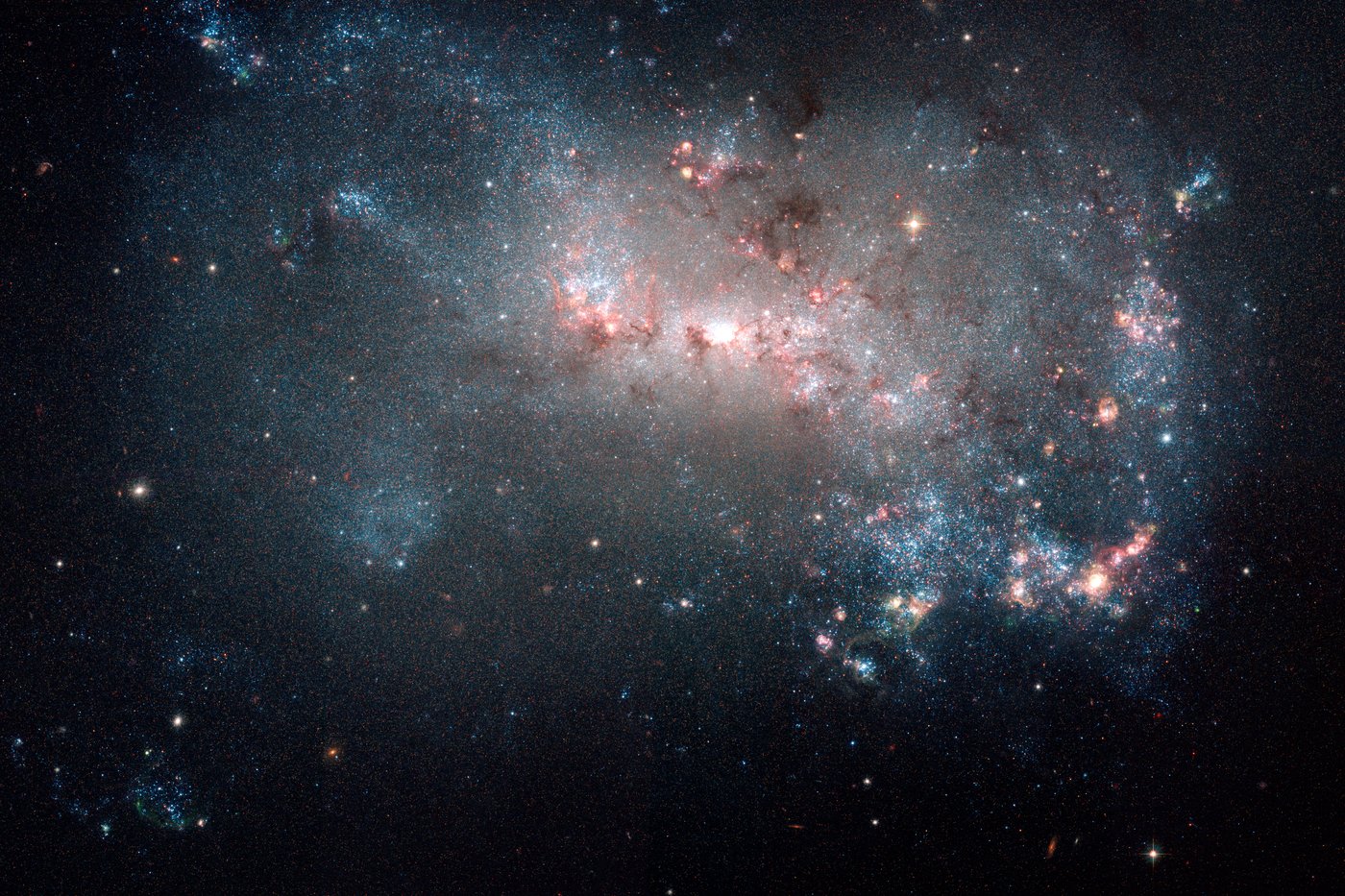
Dwarf galaxies near the Milky Way hold on to only a small share of the oxygen their stars have produced, according to a study using data from NASA's Hubble Space Telescope.
The team studied 37 dwarf galaxies within about 22 million light-years of Earth. Comparing how much oxygen the galaxies' stars made over time with how much remains in their stars, gas and dust, the researchers found the galaxies kept between 4% and 25%, about 11% on average. The work was published in The Astrophysical Journal (opens in new tab).
The researchers say galactic winds, streams of gas pushed outward by energy from massive stars and supernova explosions, appear to remove oxygen more effectively than current simulations predict. Simulations had already suggested much of the oxygen would escape, but even less remained than expected.
“We know that the oxygen had to be inside of the galaxies at some point in the past, so the oxygen must have been ejected,” said Grace Telford of the University of Utah, a co-investigator.
Hubble images let the team pick out individual stars in each galaxy and reconstruct when they formed. The researchers combined those with data from NASA's retired Spitzer Space Telescope and two radio telescope arrays.
It is not yet known whether most of the missing oxygen sits in the gas surrounding the galaxies or has traveled farther into intergalactic space, the researchers said.
The project, called Galaxies Losing Oxygen via Winds (GLOW), is led by Kristen McQuinn of Rutgers University (opens in new tab). “Being able to trace how much oxygen gets made, and then how much is distributed inside and outside of galaxies, helps us understand galaxy evolution,” she said.