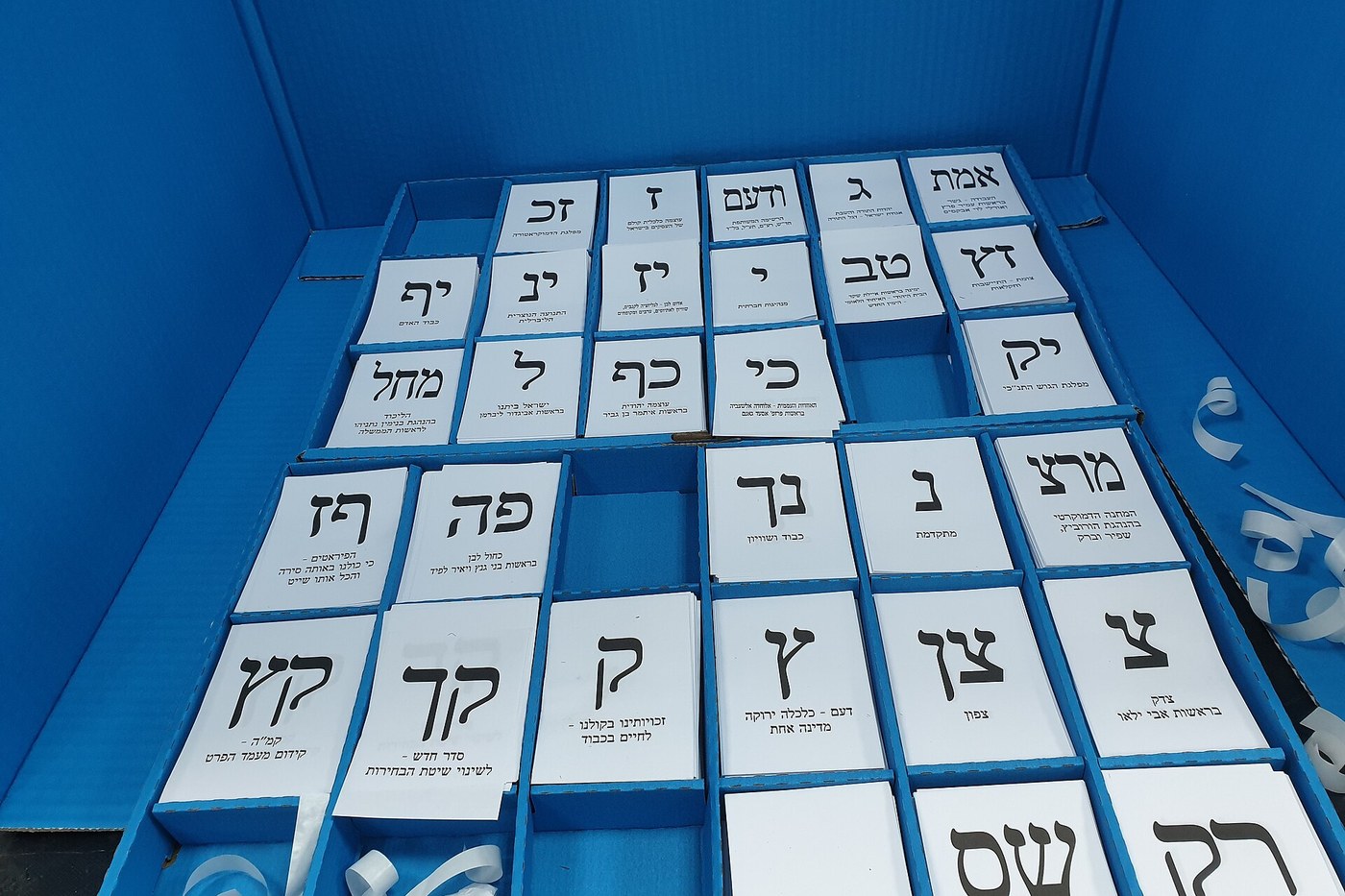
Exit polls broadcast after voting closed in Israel on Tuesday showed no clear winner in the Knesset election. The bloc of parties opposing Prime Minister Benjamin Netanyahu, led by former military chief of staff Gadi Eisenkot, finished just ahead of Netanyahu’s bloc but well short of the 61 seats needed for a majority, the BBC and CNN (opens in new tab) reported. Channel 12 projected 52 seats for Eisenkot’s bloc, 50 for Netanyahu’s and a record 18 for Arab-led parties, CNN (opens in new tab) reported. Channel 13’s poll gave the anti-Netanyahu bloc 53 seats, Netanyahu’s bloc 50 and Arab-led parties 17, the Times of Israel (opens in new tab) reported. Axios (opens in new tab) reported the exit polls as showing Eisenkot’s bloc at 52 to 53 seats, Netanyahu’s at 50 and Arab parties at 17 to 18.
In Channel 13’s poll, Netanyahu’s Likud was the largest single party with 25 seats, ahead of Eisenkot’s Yashar with 23, followed by Naftali Bennett’s B’Yachad with 14 and the Arab-led Joint List with 10, the Times of Israel (opens in new tab) reported. The paper said Likud’s showing defied weeks of surveys that mostly had it trailing. Two small parties, Reservists and People of Israel, were projected to fall short of the 3.25% threshold needed to enter the Knesset. Axios (opens in new tab) reported that Likud won one to two more seats than Yashar in the exit polls, but that bloc totals are what ultimately matter in a parliamentary system.
The BBC noted that Israeli elections can be decided by fine margins and that exit polls have been wrong in the past, and the Times of Israel (opens in new tab) said actual results often differ from exit-poll projections. CNN (opens in new tab) said exit polls are based on surveys of voters at polling stations and are not actual results. The BBC reported that preliminary results are due Wednesday and official results at the start of November, and that an estimated 600,000 absentee ballots, almost all from the military and about 10% of the total, will not be fully counted until Thursday.
The Central Elections Committee said turnout was 74.3% at 8 p.m. local time, with 5,449,277 voters, against 66.3% at the same hour in the previous election in 2022, the BBC reported. CNN (opens in new tab) said turnout had already passed the full turnout of each of the previous 10 elections. Earlier in the day the committee had reported 55.7% at 4 p.m., up from 47.5% at that hour in 2022, according to CNN (opens in new tab) and the Times of Israel (opens in new tab). Netanyahu spent much of the day posting that high Arab turnout was an “emergency” and a “matter of life or death” for the Israeli right, the BBC reported. The committee rejected a request by Likud and other right-wing parties to extend voting by an hour, saying it saw “no justification,” CNN (opens in new tab) reported. Yashar accused Likud of trying to “create a basis for claims against the integrity of the elections,” CNN (opens in new tab) reported.
Netanyahu had urged right-wing voters to “race to the polls” and said “they are trying to steal the election from us,” pointing to high turnout in Arab and left-wing areas, the Times of Israel (opens in new tab) reported. The Times of Israel (opens in new tab) called his claims of voter fraud unsubstantiated. Eisenkot’s Yashar party responded that Netanyahu “is already laying the groundwork to challenge the election results,” in the party’s words. The Times of Israel (opens in new tab) reported that several parties, including Yashar, Naftali Bennett’s party, Yisrael Beytenu, Ra’am and Yoaz Hendel’s party, also reported alleged irregularities such as missing or defaced ballot slips. The committee said there was no evidence of systematic tampering with ballot slips and that individual reports were being handled immediately, the paper reported.
Police said three men from Bedouin communities in the south were arrested overnight on suspicion of a scheme to bribe people to vote for the Arab party Ra’am, the Times of Israel (opens in new tab) reported. Ra’am called the arrests “sham arrests that aim to thwart Ra’am and bring down voting in Arab society.” The Times of Israel (opens in new tab) also reported that the Adalah legal aid group said it had received reports of long delays in Arab communities in the Galilee and the south. Police confirmed arresting a man with a knife near Democrats leader Yair Golan in Tel Aviv but denied there was an attempted stabbing, the paper reported.
The BBC said high Arab turnout could shrink both main Jewish blocs and knock out some smaller parties, making it very difficult for anyone to form a government without at least one of the Arab-led blocs, the United Arab List (Ra’am) and the Joint List. Most leading Jewish parties have ruled out working with them, the BBC said. If neither bloc wins a majority, Netanyahu would remain caretaker prime minister while President Isaac Herzog nominates a party leader to try to form a government, a process that can take weeks or months, according to the BBC. After voting in Herzliya, Eisenkot said: “We are setting Israel on a new path.”