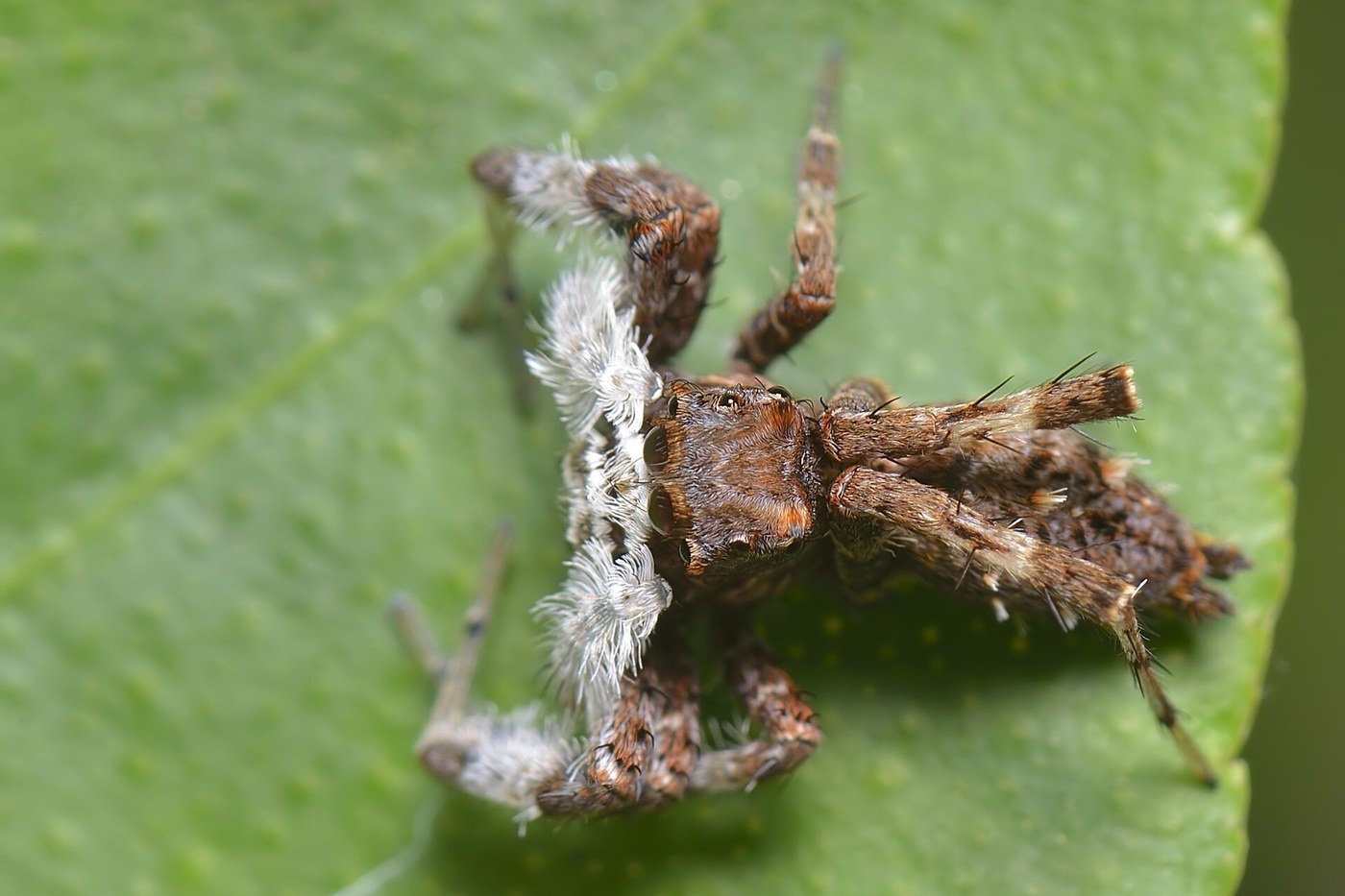
Jumping spiders that were kept from resting at night made up for it the next night with more REM-like sleep, according to a study published online Monday (Tuesday in Australia) in the Proceedings of the National Academy of Sciences. Behavioral ecologists Nadja Geiger and Daniela C. Rößler of the University of Bonn in Germany studied the fringed jumping spider, Portia fimbriata, which lives across northern Australia, ABC News Australia and ScienceAlert (opens in new tab) reported. Science magazine also covered the study.
The team used infrared cameras to record the spiders overnight, ScienceAlert (opens in new tab) reported. The spiders were mostly active by day and settled into a resting position at night, and they responded less to disturbances while resting, especially during REM-like episodes, the outlet said. Those episodes involved twitching limbs, trembling mouthparts and moving retinas, ScienceAlert (opens in new tab) reported.
ABC reported that the team saw at least two stages of sleep. In the first, which the researchers called quiescent, the spiders groomed and slowly drooped over the course of the night. A REM-like stage followed, with leg curls, eye movements and arm twitching, ABC reported. When the researchers woke the spiders with a loud noise, the animals took longer to respond in both the quiescent and REM-like stages than when awake. “This effect was particularly strong during the REM-like phase,” Geiger told ABC. “Responses were significantly delayed, and some spiders did not respond at all.” Science put the delay at up to 3 seconds.
To test whether the spiders needed that sleep, the researchers put live fruit flies into their enclosures at night to disturb their rest, 25 of them per enclosure according to ScienceAlert (opens in new tab) and more than 20 according to Science. The next night the spiders spent nearly 80% more time in REM-like behavior than before the disruption, ScienceAlert (opens in new tab) reported. They did so through more episodes, not longer ones, the outlet said. Science described the result differently, reporting that the spiders spent about one more hour resting than on previous days. The authors call the REM finding a rebound. “To our knowledge, this is the first demonstration of REM rebound in an invertebrate, which makes the finding particularly exciting,” Geiger and Rößler told ScienceAlert (opens in new tab).
The same group reported in 2022 that another jumping spider, Evarcha arcuata, showed REM-like behavior, but the researchers had not shown then that the animals were asleep, ScienceAlert (opens in new tab) reported. Thomas White, an entomologist at the University of Sydney who studies invertebrate behavior and was not part of the study, told ABC that the new work “goes a step further in mapping out different behavioural facets of sleep-like behaviour.” He called it “far and away the most complete behavioural case for sleep in any arachnid.” Alex Winsor, a neuroethologist at Columbia University who was not involved, told Science that the finding that the spiders sleep pushes toward the idea that they experience a more complex sensory world than their immediate surroundings.
The researchers did not test what REM-like sleep does for the spiders, ScienceAlert (opens in new tab) reported. Geiger and Rößler told the outlet they suspect it plays a role in information processing, as REM sleep does in vertebrates, including learning and memory. They are now planning to study spider sleep in the wild, including in northern Queensland and Western Australia, ABC reported.