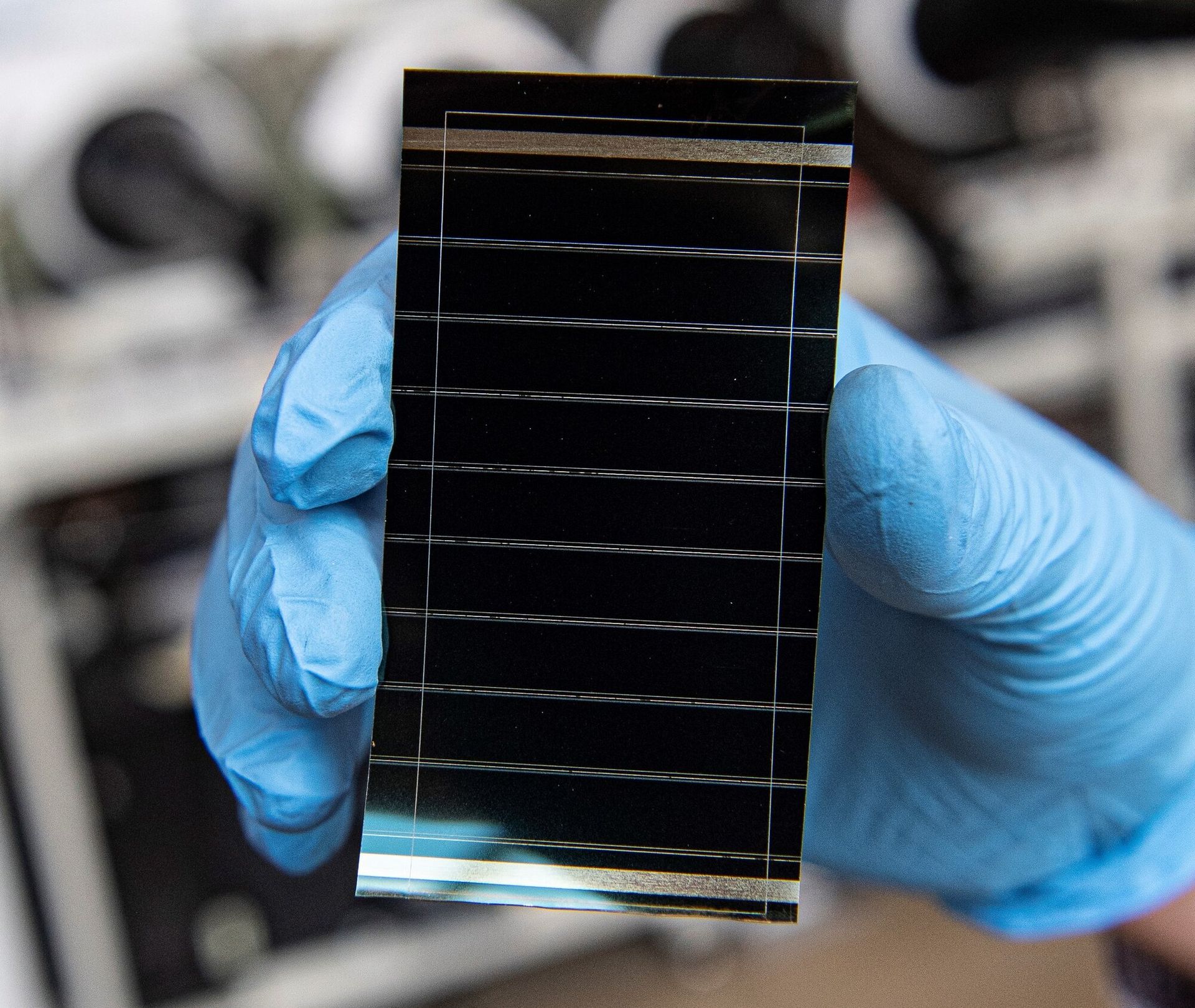
Researchers led by Nanjing University report a perovskite–silicon tandem solar cell built on industrial textured silicon that reached 30.77% efficiency in an independently certified reverse-scan measurement, according to pv magazine (opens in new tab)’s account of a Nature Communications (opens in new tab) paper published Aug. 11. The paper’s results section reports that certified reverse-scan efficiency of 30.77%, with an open-circuit voltage of 1.915 V over a 1.164 cm² active area, and a certified stabilized efficiency of 30.51% under maximum-power-point tracking for more than 300 seconds. The paper’s abstract, which pv magazine (opens in new tab) quotes, gives 30.77% as the certified stabilized tandem efficiency.
Pyramid textures on commercial silicon cut reflection but make it hard to deposit uniform perovskite films. The team applied a methylammonium thiocyanate (MASCN) “healing intervention” after film formation to promote crystal growth while keeping conformal coverage, then completed a hybrid two-step perovskite stack on n-type double-textured wafers.
A standalone wide-bandgap perovskite cell reached a champion 21.1% efficiency in the study. An encapsulated tandem started at 28.4% efficiency and retained that initial performance after 3,400 hours of continuous maximum-power-point tracking under one-sun illumination in ambient conditions — among the stronger stability results reported for such tandems, the authors say.
Collaborators included Renshine Solar (Suzhou), the Zhejiang Provincial Innovation Center of Laser Intelligent Equipment Technology, Yunnan University and Sweden’s Uppsala University. The paper declares that one of its two corresponding authors, Hairen Tan, founded and chairs Renshine Solar. Lab-scale certified efficiencies do not automatically translate to factory modules; moisture sensitivity, lead content and long-term outdoor yield remain industry hurdles for perovskite commercialization.