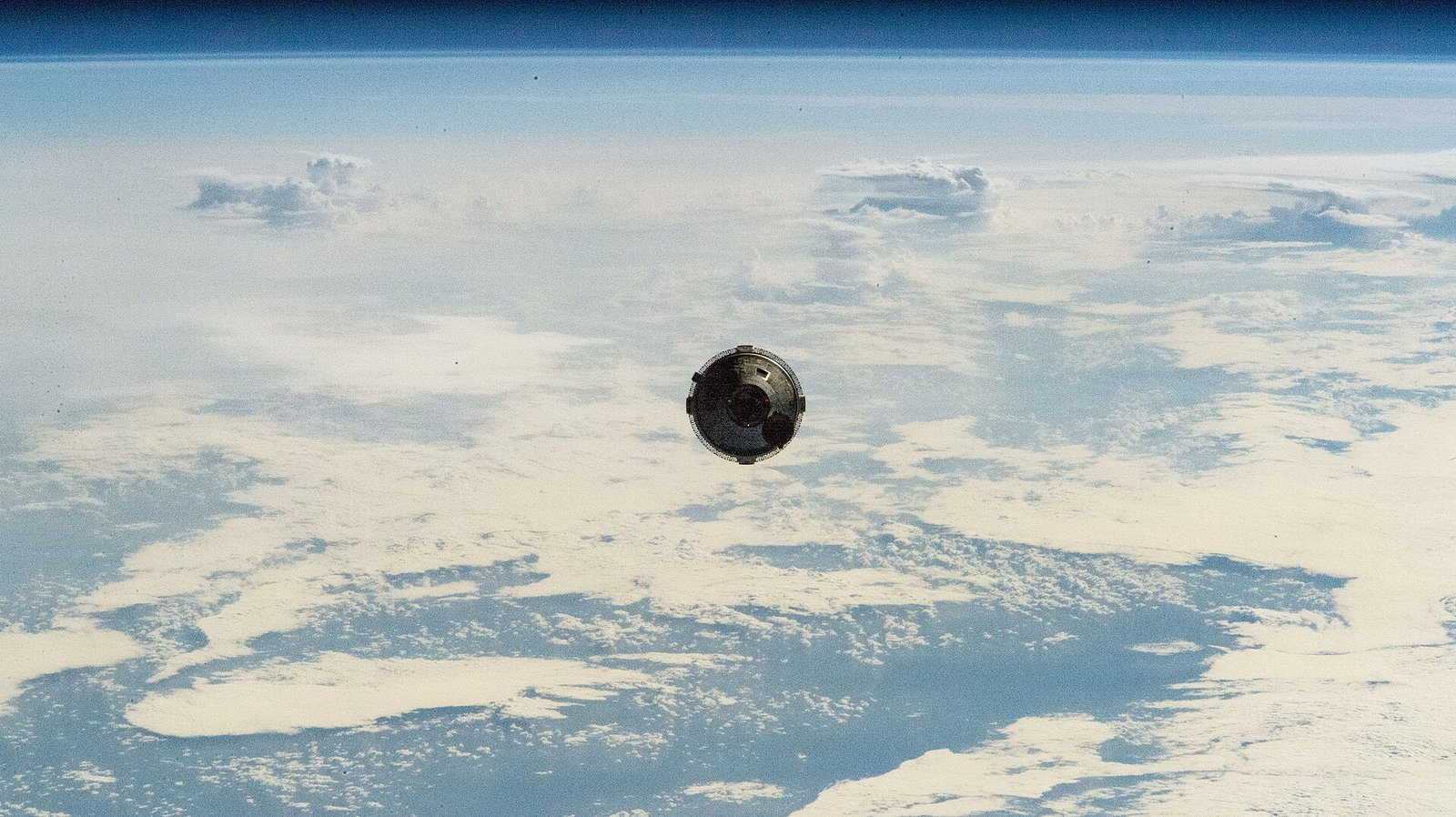
NASA and Boeing said Monday that they plan to launch Boeing’s uncrewed Starliner-1 mission to the International Space Station in the December 2026–January 2027 time frame, followed by a crewed Starliner-2 mission in 2028, according to Boeing and Space.com (opens in new tab). If the uncrewed flight goes well, the partners hope to fly astronauts in mid-2028, Spaceflight Now (opens in new tab) and CBS News (opens in new tab) reported. Space.com (opens in new tab) said Boeing representatives described the crewed launch as likely in the middle of that year.
Starliner-1 will carry cargo to the station, according to Boeing, and will rendezvous and dock there while flight controllers exercise the thrusters and their pressurization systems, Spaceflight Now (opens in new tab) reported. “We really need to see how those thermal modifications perform on the spacecraft, and we intend to put the propulsion system through its paces,” said Dana Weigel, manager of NASA’s low-Earth orbit operations, according to Spaceflight Now (opens in new tab) and CBS News (opens in new tab). She said the mission would fly with stricter performance parameters when the capsule is near the station.
NASA named veteran astronaut Warren “Woody” Hoburg commander of Starliner-2; his crewmates have not been named, according to Spaceflight Now (opens in new tab) and Space.com (opens in new tab). “I've flown a lot of types of aircraft, and let me tell you, Starliner is a pilot's spacecraft,” Hoburg said at Monday’s news conference, Space.com (opens in new tab) reported.
The new schedule follows the 2024 Crew Flight Test. NASA astronauts Butch Wilmore and Suni Williams launched aboard Starliner on June 5, 2024, for a test flight billed as lasting about 10 days, but ran into helium leaks and thruster failures on the way to the station, Spaceflight Now (opens in new tab) reported. Starliner returned to Earth without its crew three months after launch, and the two astronauts came home aboard a SpaceX Crew Dragon on March 18, 2025, after 286 days, according to Spaceflight Now (opens in new tab). An independent review board classified the propulsion problems as a “close call,” Spaceflight Now (opens in new tab) and CBS News (opens in new tab) reported, and NASA declared the flight a “Type A mishap,” its most serious category, in February, according to Space.com (opens in new tab).
Under a contract modification announced Monday, Boeing said it will replace valves on all 12 crew module reaction control thrusters and add measures to prevent corrosion, redesign service module thruster poppets, record thruster chamber pressure more often, improve a parachute joint and integrate NASA-provided upgraded batteries. Space.com (opens in new tab) reported that the helium leaks were traced to valve problems, specifically degradation after exposure to the oxidizer nitrogen tetroxide, and that Weigel said the seal material was changed as a result; she also said a crew module thruster problem was the result of corrosion. Some fixes, including a service module thruster valve design change, will be completed only after Starliner-1, Space.com (opens in new tab) reported, citing a NASA statement. Boeing said 19 of 21 in-flight anomalies from the crew flight test are closed and the rest are expected to close in October.
Weigel put the cost of the spacecraft upgrades and certification of United Launch Alliance’s Vulcan rocket for crewed flights at $359 million, Space.com (opens in new tab) reported. Only about half a dozen of the Atlas 5 rockets that have launched Starliner remain in ULA’s inventory, according to Spaceflight Now (opens in new tab), and Space.com (opens in new tab) said the fifth and sixth Starliner missions will fly on Vulcan. Boeing said the contract change also restores those two missions.
“It's always been the Commercial Crew Program's goal to have two crew transportation providers to ensure commercial access to low Earth orbit,” Weigel said, according to Spaceflight Now (opens in new tab) and CBS News (opens in new tab). “As SpaceX has publicly stated, the Dragon and the Falcon won't be around forever.” SpaceX’s Crew Dragon is currently the only operational U.S. astronaut transport, and NASA wants a second U.S. capability through the station’s planned retirement in 2030 and for commercial stations later in the 2030s, Spaceflight Now (opens in new tab) reported.