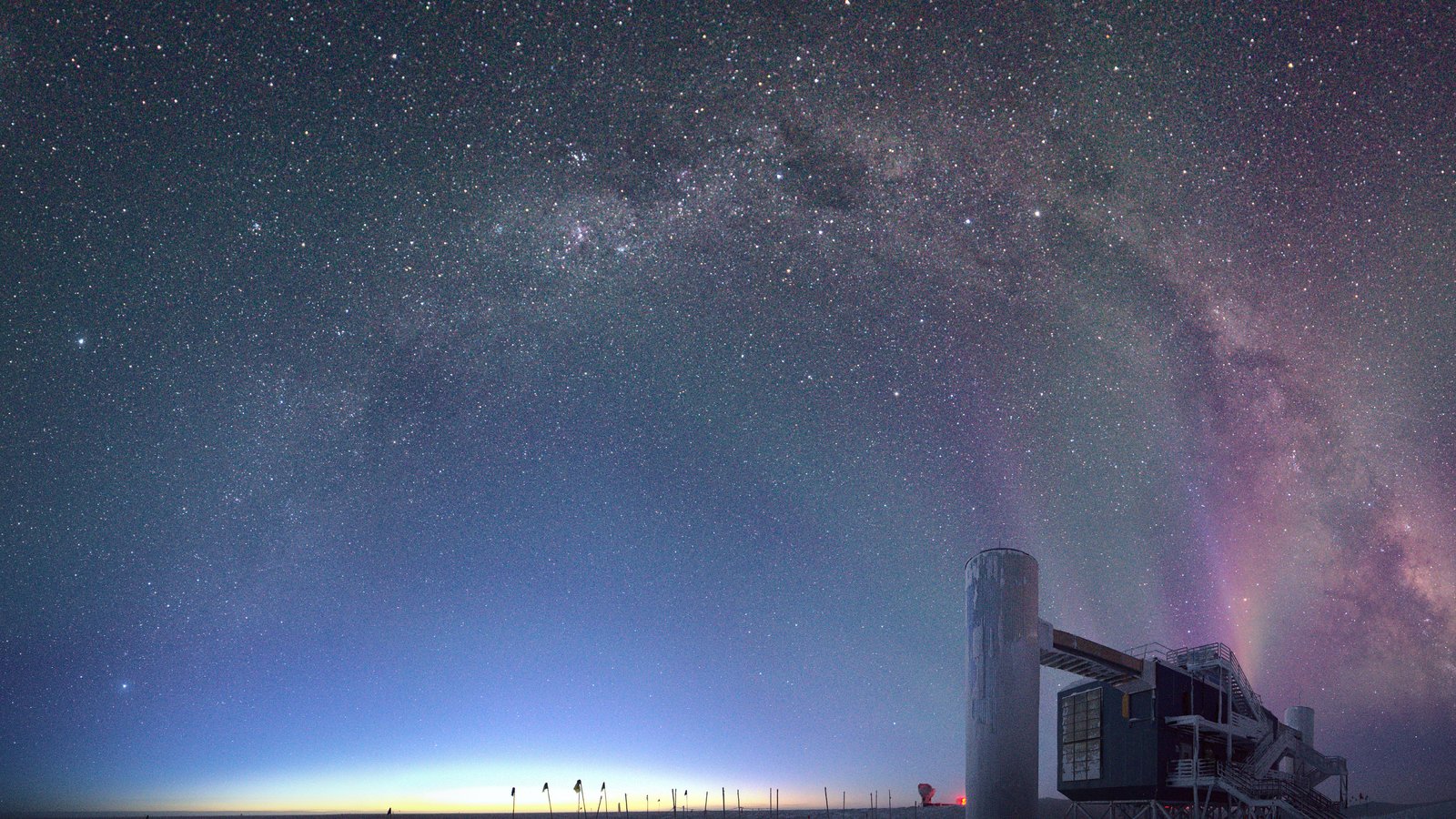
The Royal Swedish Academy of Sciences on Tuesday awarded the 2026 Nobel Prize in Physics to Francis Halzen of the University of Wisconsin–Madison “for decisive contributions to the IceCube Neutrino Observatory and the discovery of high-energy neutrinos of astrophysical origin.” He is the sole laureate and will receive 12 million Swedish kronor, about $1.2 million.
Neutrinos are tiny particles that almost never interact with matter. Trillions pass through a person’s body every second. Because they travel in straight lines and are not deflected by magnetic fields, high-energy neutrinos can point back toward the violent cosmic events that produced them. The academy says they can provide information “that is not available in any other way.”
Halzen first presented his idea of detecting neutrinos at the South Pole in 1988. When a neutrino hits an atomic nucleus in the ice, it produces a faint flash of light that buried sensors can record. Antarctica’s deep ice is clear, stable and free of earthquakes. Because such collisions are so rare, IceCube needed a full cubic kilometer of ice fitted with sensors. It was completed in 2011. Researchers soon detected the first high-energy neutrinos and, a few years later, published evidence of neutrinos from far outside the solar system.
“His tenacity and scientific vision has paved the way for a new kind of astronomy,” said Mark Pearce, chair of the Nobel Committee for Physics. Speaking by phone from Italy, Halzen said, “It was a great surprise and I obviously didn’t expect it,” the Associated Press reported. At a news conference he told reporters, “I have to emphasise how lucky I was,” the BBC reported. He said few people, himself included, had thought the project would work.
Halzen was born in 1944 in Tienen, Belgium, and earned his doctorate from KU Leuven in 1969, according to the academy. Belgian Prime Minister Bart De Wever noted that Halzen is the 11th Belgian to win a Nobel Prize and the second in physics, DW (opens in new tab) reported. The medicine prize was announced Monday. Chemistry follows Wednesday, literature Thursday, the peace prize Friday and economics next Monday.