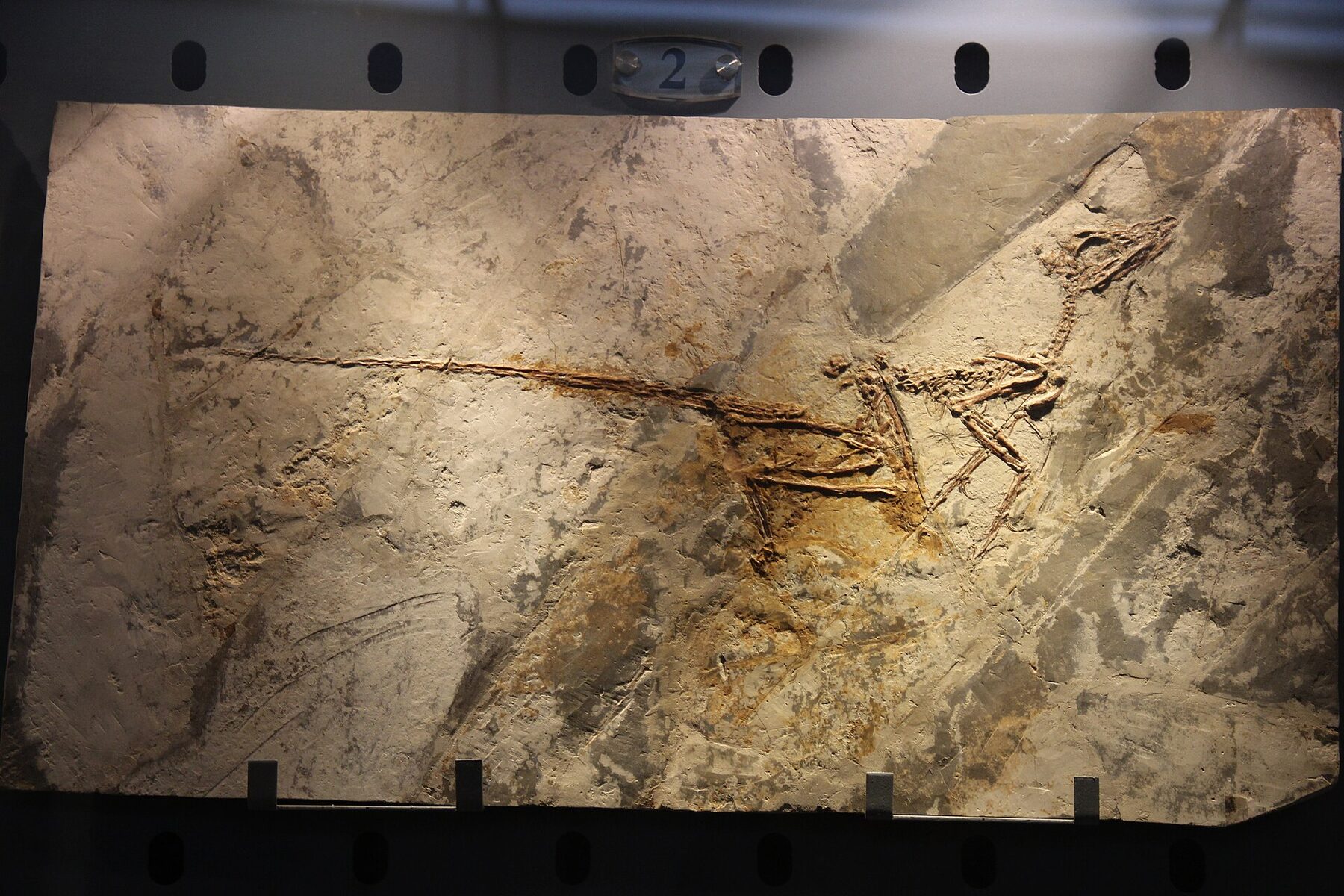
An international team of researchers has described a new species of small, feathered dinosaur from northeast China and says its anatomy supports the idea that flight evolved independently in more than one dinosaur lineage. The paper, “Independent assembly of the flight apparatus in a non-avian dinosaur clade,” by Xuri Wang, Yannan Ji, Andrea Cau and colleagues, was published Sept. 29 in Nature Communications (doi:10.1038/s41467-026-77804-6). The team includes researchers from China, Italy and Slovakia, Nature and the South China Morning Post (opens in new tab) reported.
The species, Norellraptor barsboldi, is a microraptorine, part of a group of dromaeosaurid dinosaurs known for feathered forelimbs and hindlimbs. According to the paper, the complete skeleton, with part of its plumage impressions preserved, came from the Lower Cretaceous Jiufotang Formation near Lamadong Town in Jianchang County, western Liaoning. It was found by a local farmer and donated to the Museum of Hebei GEO University in 2023, the authors wrote. The skeleton is 57 centimeters long, the paper says.
The authors named the genus for American paleontologist Mark Allen Norell (1957–2025) and the species for Mongolian paleontologist Rinchen Barsbold (1935–2025). From bone tissue in the forelimbs, they estimated that the animal was “minimally three years old when it died.”
In their analysis, the researchers found 194 anatomical traits that mark the microraptorine branches of the family tree, and wrote that about 30% of them, 57 traits, were also acquired separately along the lineage leading to birds. But the order in which flight-related features appeared differed between the two groups, they wrote, and so “could not be considered the expression of a shared developmental regime.” The abstract says the results “support multiple and independent selective regimes at the origin of the winged taxa in Paraves,” the larger group that includes birds and their closest relatives.
“The study provides important new evidence that further supports the hypothesis that flight evolved multiple times among feathered dinosaurs, including at least once among microraptorines and at least once among birds,” Michael Pittman, a paleobiologist at the Chinese University of Hong Kong who was not an author, told Nature. Neil Gostling of the University of Southampton told Nature the study shows that many species “were exploring all of the avenues open to them.”