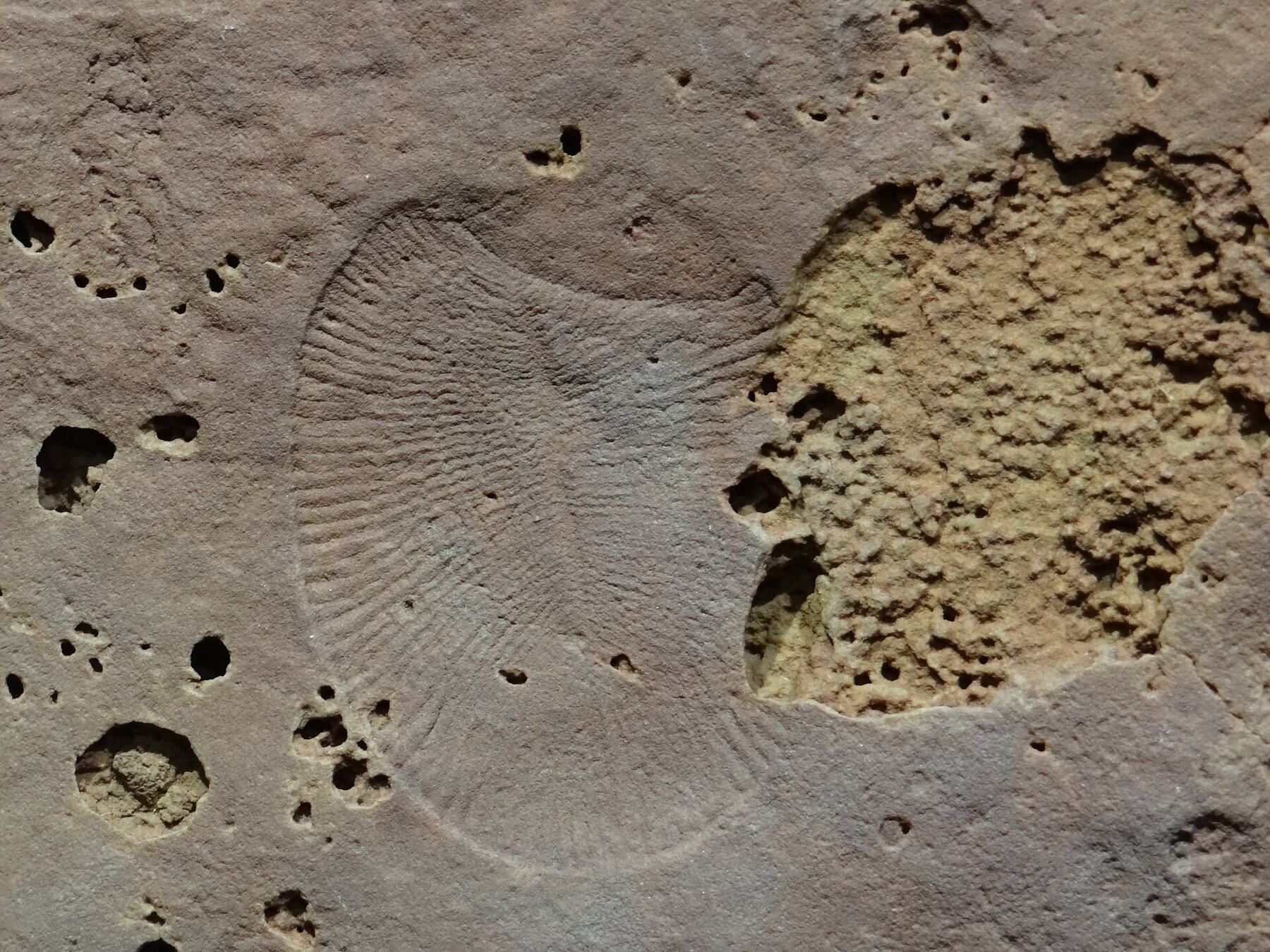
Animals may have originated between about 800 million and 700 million years ago, according to a study published Oct. 2 in Science Advances, as much as 200 million years before the oldest known animal body fossils, which date to 574 million years ago. The paper, “Re-evaluating molecular clock maximum age calibrations revives pre-Ediacaran divergence estimates for animals,” is by Orin M. Lole Durbin, Eliel S.C. Anttila, Derek E.G. Briggs, Francis A. Macdonald and Ross P. Anderson (doi:10.1126/sciadv.aeg6289). “Our analyses support a late Tonian to mid-Cryogenian (∼800–700 Ma) origin for Metazoa,” the authors wrote, using the scientific name for animals.
Molecular clocks estimate when lineages split by comparing genetic differences among living species and using dated fossils as reference points. The study’s abstract says that lipid biomarkers, chemical traces in rocks, suggest animals originated before 635 million years ago, but that their body fossil record extends only to 574 million years ago, and that the accuracy of clock estimates hinges on the maximum ages used to calibrate them.
Some researchers have used a roughly 590-million-year-old deposit in China, the Weng’an Biota, as that maximum, reasoning that its exceptionally preserved microfossils would have included animals if they existed, according to a University of Oxford release. To test that assumption, the team studied more than 140 samples from Mongolia’s Kheseen Biota, which the paper dates to about 550 million to 526 million years ago, a time when animals were “undoubtedly present.” The Oxford release says the samples revealed new microfossil species and embryo-like fossils with internal cells, but none could be confidently identified as an animal.
“The Kheseen Biota breaks the argument that the exceptional microfossils of Weng’an mean we would have seen animal fossils in the assemblage had they existed at the time,” said Anderson, an associate professor at Oxford’s Museum of Natural History and the study’s senior author. Instead, the researchers calibrated their clocks with older, well-preserved deposits from about 850 million to 730 million years ago in Norway’s Svanbergfjellet Formation, Australia’s Bitter Springs Group and Arizona’s Chuar Group, according to Yale University. That shifted the estimated origin of animals back by around 200 million years, the Oxford release says.
The authors cautioned against reading the result as proof. “Pre-Ediacaran animal body fossils still elude us, and this analysis does not prove that animals existed 800 million years ago,” said Lole Durbin, the first author, now a doctoral student at Virginia Tech. “Until that evidence becomes available, the precise birth date of the animal kingdom remains uncertain,” Anderson said. Briggs, a Yale paleontologist, said, “Future discoveries are needed to refine our knowledge of the nature and timing of the earliest animal life on the planet.”
Karma Nanglu, an assistant professor of evolutionary paleobiology at the University of California, Riverside, who was not involved in the study, told Live Science (opens in new tab) that, with animals’ origin predating their fossils, the question is “how much does it predate our first fossil discovery by and what happened in that evolutionary black box between when they actually originated versus when we get our first fossil window.” A 2024 Science Advances study by Emily Carlisle, Zongjun Yin, Davide Pisani and Philip C. J. Donoghue, using revised fossil calibrations, estimated that animals originated in the early Ediacaran, a result its authors said was “in much closer accord with the fossil record.”