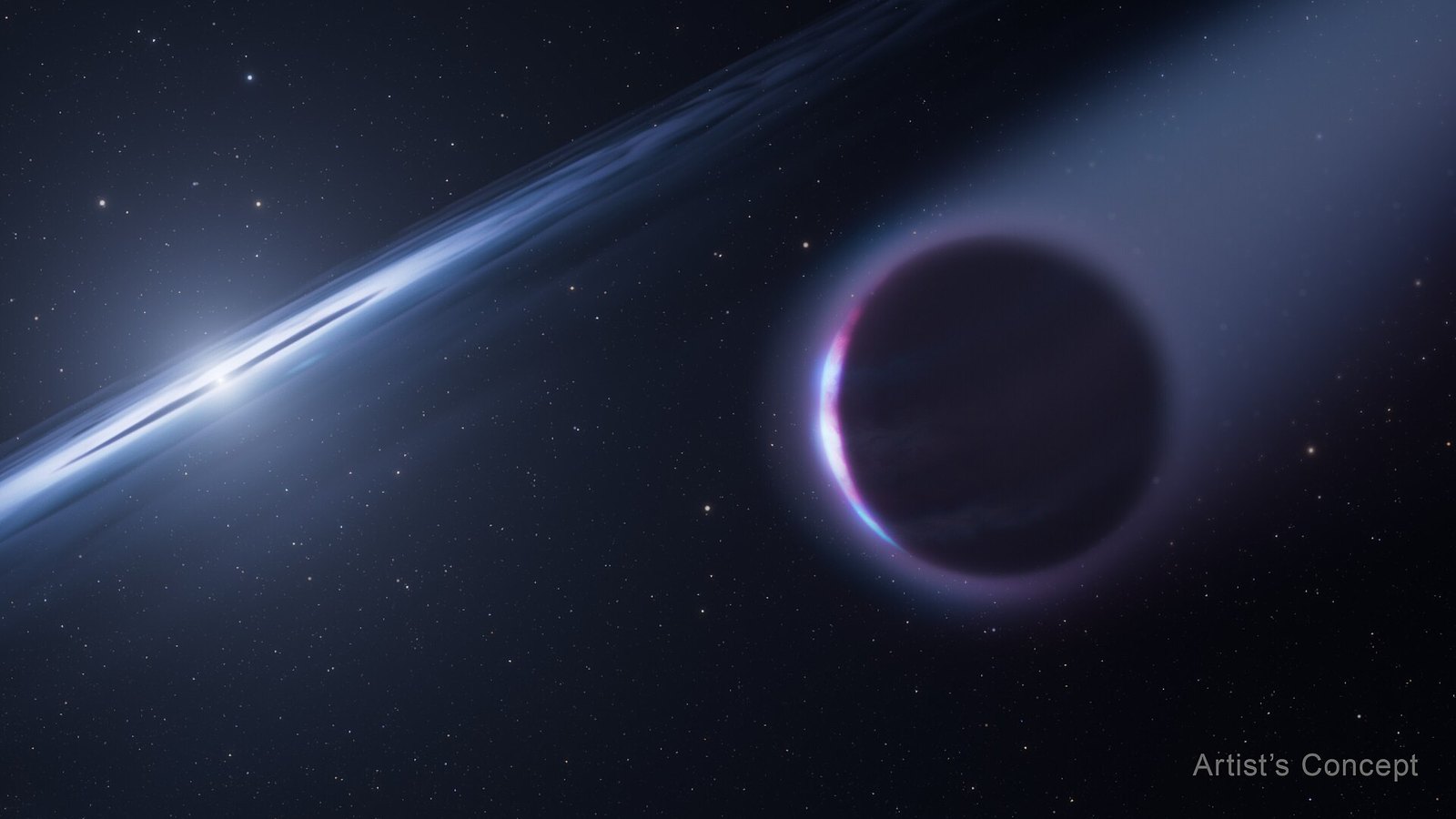
Astronomers have found evidence of what may be the first known planet to form from the material a star cast off as it died, according to a paper published Oct. 5 in Nature Astronomy. The candidate world orbits HS 0209+0832, a hot, young white dwarf, and the authors describe it as a “second-generation planet candidate.”
White dwarfs often show traces of rocky debris from shattered planets, usually dominated by silicon and iron. The team, led by University of Warwick doctoral student Jamie Williams, reanalyzed Hubble Space Telescope ultraviolet data first gathered in 1999 and found the star’s atmosphere strongly enriched in zinc, copper and niobium but depleted in silicon and iron. Warwick said niobium was present at levels more than 1,000 times the sun’s; Williams told Science News (opens in new tab) the team had “never observed anything in the universe that’s this niobium-rich before.”
Those heavy elements are made by the s-process, a nuclear reaction inside dying red giant stars. The researchers argue that matter the star shed late in its life formed a new disc and then a gas giant, whose evaporating atmosphere is now falling onto the white dwarf. Data from NASA’s TESS satellite showed a brightness signal repeating about every 4.4 days, which the authors attribute to a close-in planet’s day–night cycle or a transiting tail of evaporating gas.
“We’re not really sure, if it’s not a planet, what it is,” Williams told Science News (opens in new tab). “A planet is the most reasonable explanation.” Zifan Lin, a planetary scientist at Washington University in St. Louis who was not involved, told Science News (opens in new tab) that the formation process had previously been “more like a hypothesis, more like speculation.”