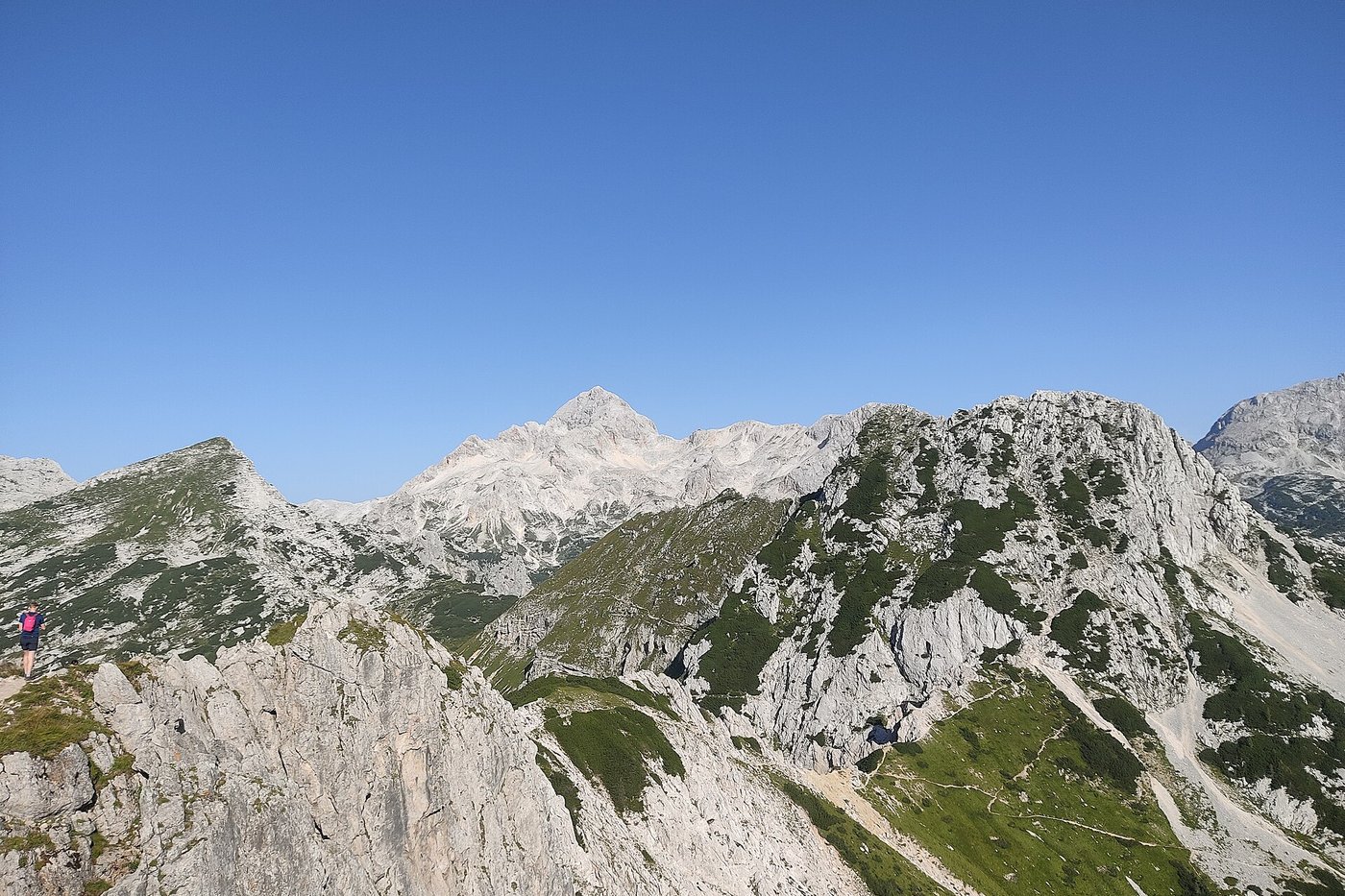
The last ice has melted from the Triglav glacier on Slovenia's highest mountain, researchers say. It is the latest Alpine glacier lost to this year's scorching European summer, which was the hottest on record in western Europe.
Photographs of the mountainside taken before and after snowfall this month confirm that no ice remains, The Guardian (opens in new tab) reported, citing the Anton Melik Geographical Institute, whose researchers have measured the glacier for decades. A Reuters photo from Oct. 2 showed what was then the last fragment.
The glacier lost 93% of its area between 1983 and 2003 and shrank to less than a hectare, but it lasted two more decades. Over the past five years, which include Europe's three hottest years on record, the remaining ice broke into small isolated patches. By the end of this summer the last piece of the main body was only a few meters across, The Guardian (opens in new tab) reported.
“This year, there was very little snow, and it melted quickly. Extremely high summer temperatures also caused the glacier to disappear faster,” Miha Pavšek, a geographer at the institute, told Slovenian news site Časoris. He said the last pieces melted shortly before the first autumn snow fell at Kredarica, a weather station near the summit.
Matija Zorn, the institute's director, said Mount Triglav “holds a central place in Slovenian national identity.” He said the glacier's loss means losing an important source of data on climate change. “Every year I knew that the ice was going to be less and less,” he told The Guardian (opens in new tab). “But I was shocked every year [by] how much less ice was up there.”
The glacier covered about 40 hectares in the mid-1800s and 14 hectares when it was first formally measured in 1946, according to The Guardian (opens in new tab). Ice remains in caves beneath Triglav. A second Slovenian glacier, under Mount Skuta, has also thinned but is better shaded and is expected to last a few more years.
Triglav appears on Slovenia's flag. Last month Swiss glaciologists reported that nearly a fifth of Switzerland's glacier ice had disappeared in five years, including a 5.5% loss in volume in 2026.