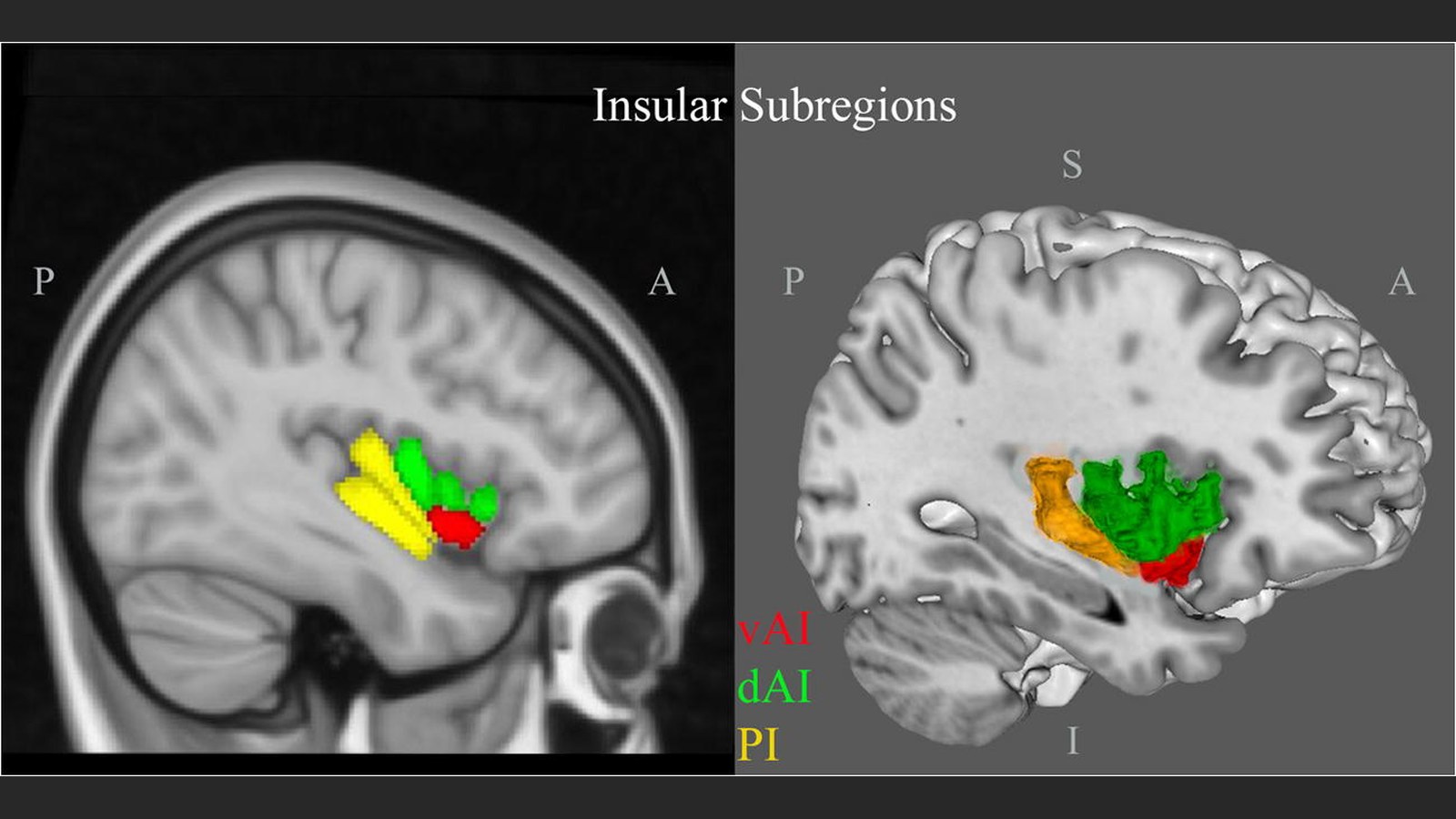
Researchers led by Stanford University physician-scientist Josef Parvizi have divided the human insula, a region buried deep beneath the brain’s surface, into four functional regions by stimulating it directly in 87 people who already had electrodes implanted for medical reasons, according to a paper published Wednesday in Nature and an accompanying Nature news report.
In experiments spanning more than a decade, the team sent electrical currents into sites across participants’ insulas, Nature’s news team reported. Stimulating the rear of the insula produced pain, heat and sensations such as tingling and numbness in specific parts of the body, while stimulating the middle produced internal sensations including nausea, pressure and a feeling of fullness in the chest.
The paper describes a rear-upper region that encodes pain, temperature and touch organized by body part; a rear-lower region with access to sensations across multiple body parts; a mid-front region associated with visceral sensations and anxiety; and a front region that was largely silent when stimulated but became active when participants detected salient events and switched behavior. That front region, which has strong links to the prefrontal cortex, exerts strong and direct influence over the other insular regions while receiving weaker, indirect input from them, the authors wrote, describing “an electrophysiological pathway for cognitive modulation of pain and bodily perception.”
The insula is “not just reading the body. It is partly influencing the story about how the body should be felt,” Parvizi told Nature. Lucina Uddin, a cognitive neuroscientist at the University of California, Los Angeles, who was not an author, called the study “quite a feat.”
The work relied on patients with implanted electrodes because placing electrodes deep in healthy people’s brains would be unethical, Nature reported. The study maps how the insula is organized; it did not test treatments. The authors said the regional masks and connectivity data are publicly available.