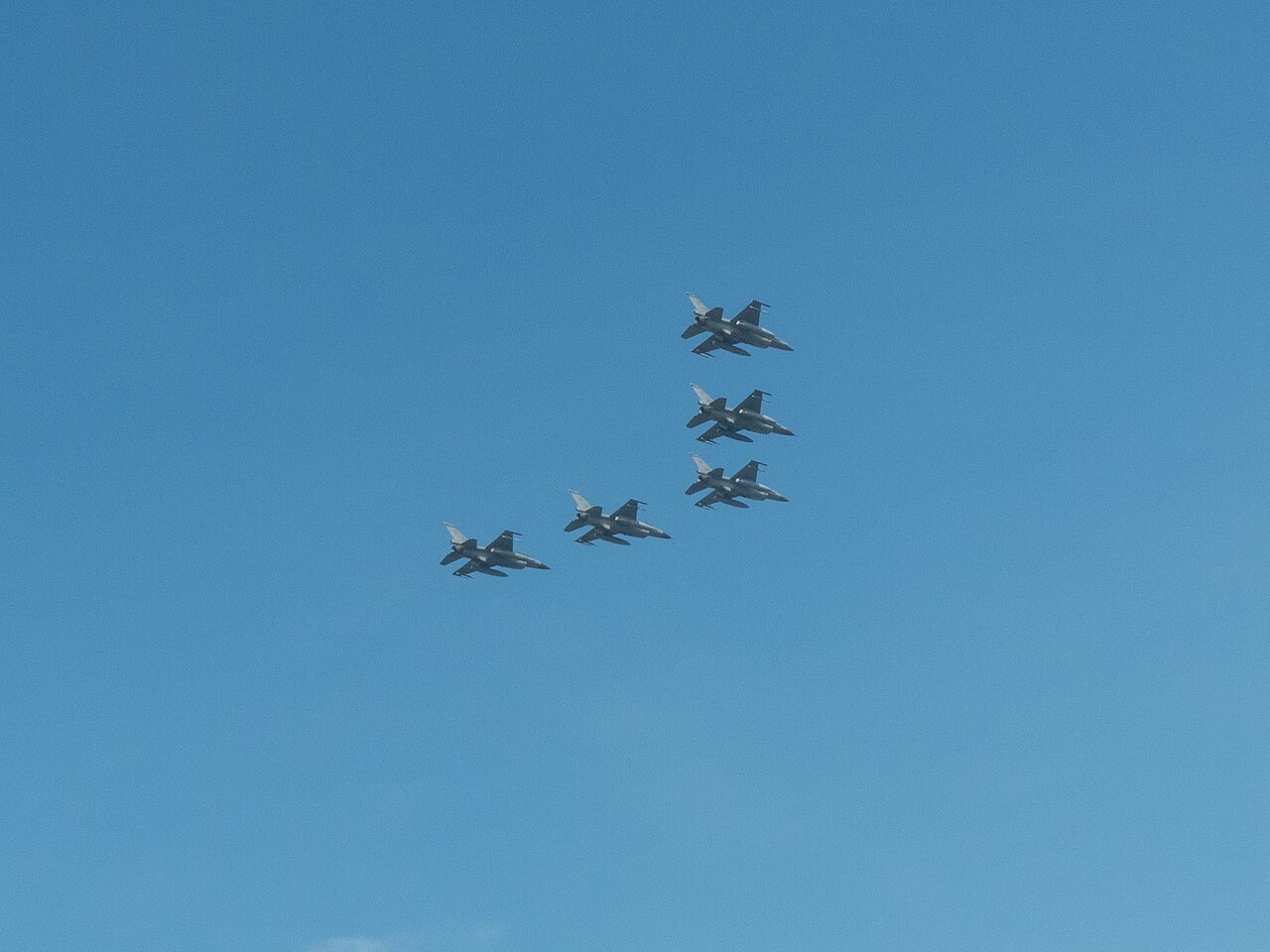
Taiwan’s Air Force on Friday received the first two of 66 Lockheed Martin F-16V Block 70 fighters purchased from the United States, Taiwan’s Central News Agency (CNA) and Reuters reported. The jets, bearing tail numbers 6727 and 6728, landed around noon at Chihhang Air Base in Taitung County after departing Hawaii and stopping in Guam. They had been expected by the end of August but remained in Hawaii without explanation as President Donald Trump prepared to meet Chinese leader Xi Jinping in late September, CNA reported; AFP (opens in new tab) said no official explanation was given.
President Lai Ching-te wrote on social media that the arrival was “an important milestone in strengthening Taiwan’s air defense capabilities,” in CNA’s English translation; Reuters rendered the same Facebook post as “an important development.” Lai said investing in national defense increases the cost of invading Taiwan and lowers the risk of miscalculation, CNA reported. Defense Minister Wellington Koo told reporters at the Legislative Yuan that “there will be more than two jets delivered this year,” according to CNA, and AFP (opens in new tab) quoted him as saying, in translation, “At present, I think aircraft are gradually moving through the production line, and there are also aircraft that have passed the tests.” The Air Force Command said in a statement that the jets will join the 7th Tactical Fighter Wing, established Dec. 1, 2023, and that some of the remaining 63 aircraft on the U.S. production line have reached the delivery stage.
Washington approved the roughly $8 billion sale of 66 F-16Vs and related equipment in 2019; delivery was expected to begin in 2023 and finish by 2026 but slipped because of technical issues, CNA reported, with Reuters citing software problems. The deal would take Taiwan’s F-16 fleet to more than 200 aircraft, Reuters reported. Separately, an upgrade of 140 of Taiwan’s older F-16A/B jets to the F-16V standard was completed in December 2023, China’s state-run Global Times (opens in new tab) reported in August, citing CNA. The Block 70 jets have advanced avionics, weapons and radar systems to better counter the Chinese air force, including its J-20 stealth fighters, though Washington has not provided Taiwan its most advanced fighters such as the F-22 or F-35, Reuters reported. Taiwan is also awaiting a separate $14 billion arms package that Trump paused, calling it in May a “very good negotiating chip” in dealings with China, AFP (opens in new tab) reported.
“Our policy on Taiwan has not changed. The United States remains committed to its one China policy, which is guided by the Taiwan Relations Act, the three Joint Communiques, and the Six Assurances,” a U.S. State Department spokesperson told CNA, adding that Washington continues “standing with friends and allies across the Indo-Pacific,” including Taiwan. China’s foreign ministry did not respond to Reuters’ request for comment on the arrival; Beijing has repeatedly told Washington to stop arming Taiwan. In August, as the first two jets were en route, the Global Times (opens in new tab) reported mainland military commentator Song Zhongping as saying the F-16V was comparable to China’s J-10C but had “no edge at all” against the J-16, J-20 and J-35, and that it “can also be destroyed on the ground.” Koo said Friday that “China’s intention to annex Taiwan by force has never changed,” Reuters reported. People familiar with U.S. thinking told Reuters that U.S. officials believe a Chinese invasion before 2028 is increasingly unlikely.