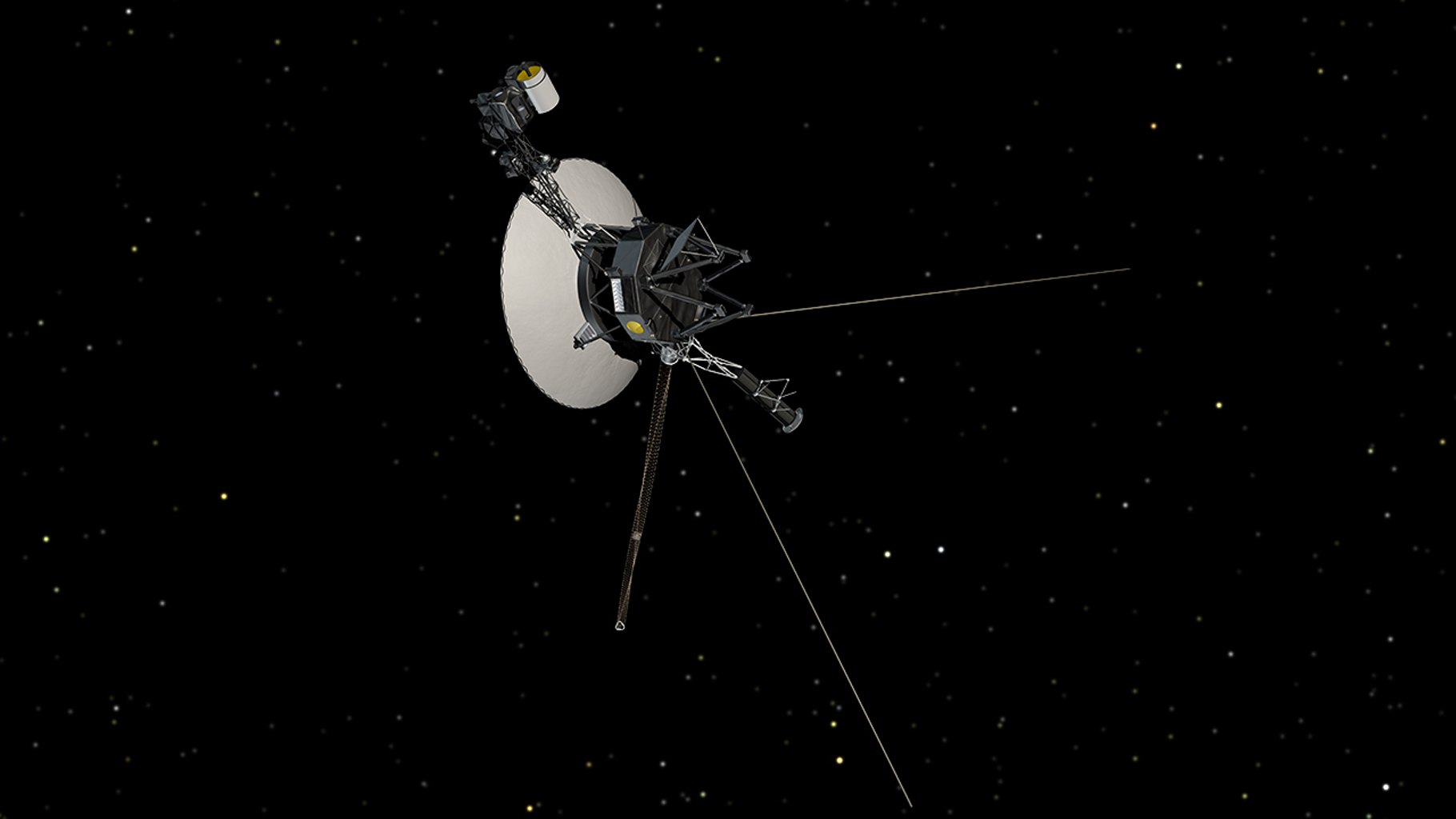
NASA (opens in new tab)'s Voyager 1 is due to become the first human-made object to reach one light-day from Earth at 5:16:07 a.m. EST on Wednesday, Nov. 18 (3:16:07 a.m. MST), according to the agency. A light-day is the distance light travels in 24 hours, which NASA (opens in new tab) puts at 16,094,799,096 miles, or 25,902,068,356 kilometers.
At that distance, a command sent from Earth takes a day to reach the spacecraft and a reply takes another day to come back. NASA (opens in new tab) said Voyager 1 will have taken 49 years, two months and 11 days to get there. It launched on Sept. 5, 1977, flew past Jupiter and Saturn, and in August 2012 became the first spacecraft to enter interstellar space. Its twin, Voyager 2, is on pace to reach one light-day in November 2035.
The probe still returns science data. BBC Sky at Night Magazine (opens in new tab) reported that its working instruments are a magnetometer, a device that measures electron density and one that measures low-energy particles, and that data arrive at Earth at typically 160 bits per second. Its plutonium power source now produces about half the power it did at launch, and the magazine said that by 2036 its signal is expected to be too faint for NASA (opens in new tab)'s antennas to detect.
Voyager 1 is traveling at nearly 38,000 mph and is expected to pass within about 1.7 light-years of the star Gliese 445 in about 40,000 years, NASA (opens in new tab) said. The agency has invited people to mark the milestone after sunset on Tuesday by flashing lights toward the sky.