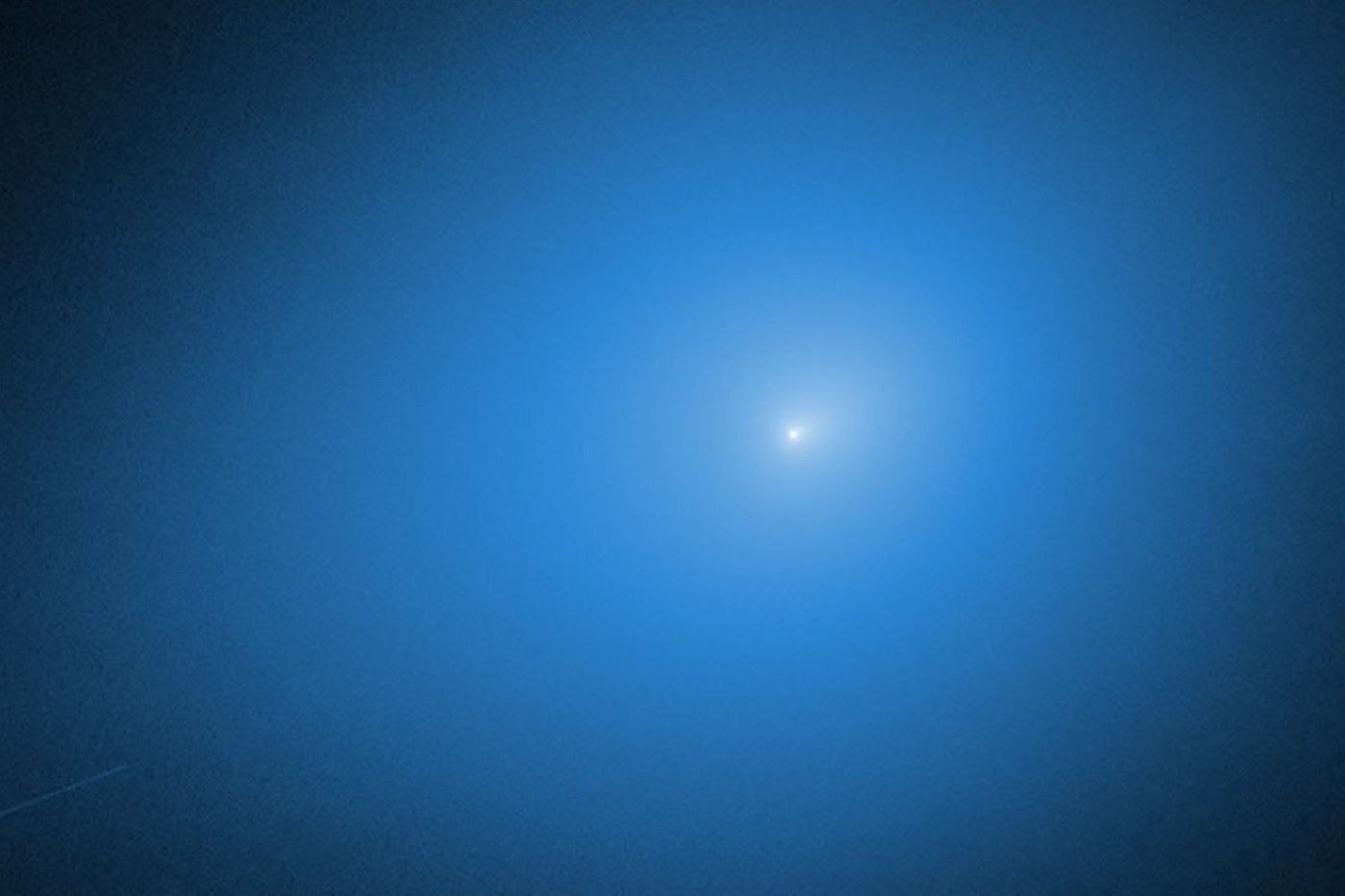
Ice streaming from the interstellar comet 3I/ATLAS appears to be packed into tiny grains heavily mixed with dust, according to a study using NASA's James Webb Space Telescope. 3I/ATLAS is only the third object from outside the solar system ever identified.
The study was led by Silvia Protopapa of the Southwest Research Institute (SwRI) and published in The Astrophysical Journal Letters. The team observed the comet with Webb's Near-Infrared Spectrograph three times between August 2025 and April 2026, before and after its closest approach to the sun.
Water ice usually shows three absorption bands in infrared light: a strong one near 3 microns and weaker ones near 1.5 and 2.0 microns. In 3I/ATLAS, the 3-micron band was strong but the other two were very weak or missing. “That combination was a puzzle,” Protopapa said in an SwRI release.
Comparing the data with models of how light scatters off different particles, the team found the best fit was grains about a micron across or smaller, made of water ice mixed with dust. In such grains, light passes through only a little ice, which weakens the shorter-wavelength bands. “The grains of 3I/ATLAS are about the same size as those in our own comets,” Protopapa said. “What seems to set them apart is how much dust is mixed into the ice.”
The grains seemed to change over time. By the last observation in April 2026, as the comet moved away from the sun, the data pointed to an additional group of larger, ice-rich grains. Co-author Michael Kelley of the University of Maryland said the team cannot yet tell whether that came from the sun heating the grains differently or from fresh material exposed as the comet's surface eroded.
The researchers then compared the comet with Webb spectra of trans-Neptunian objects, icy bodies beyond Neptune that are thought to preserve material from the early solar system. The water-ice band of 3I/ATLAS resembled those seen in several groups of these objects, which also lack strong bands at 1.5 and 2.0 microns.
If the pattern holds, the team says, the physical form of water ice may be set early in planet-forming disks around many stars. They say future Webb observations of comets and new interstellar visitors are needed to test the idea and to learn whether 3I/ATLAS is typical.